


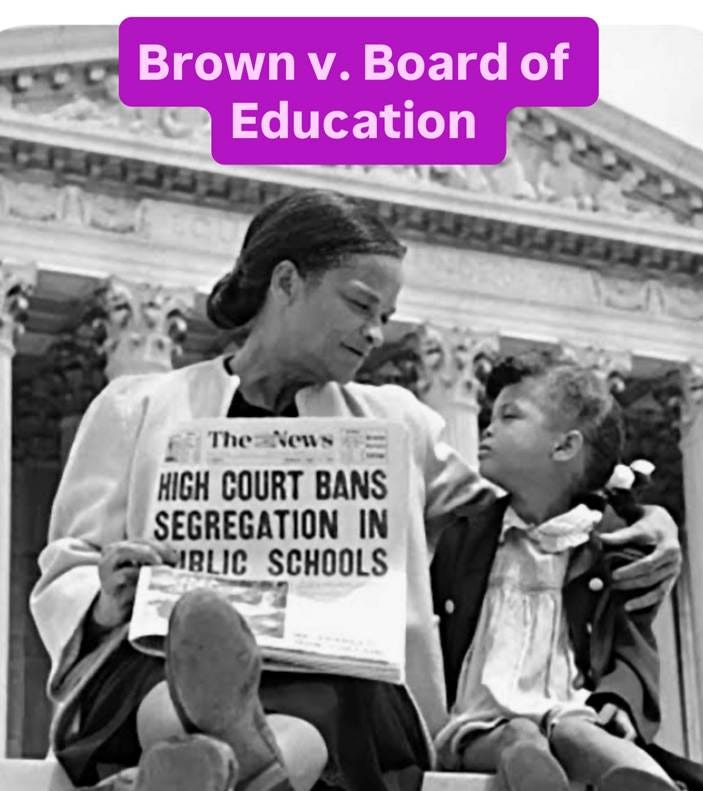
On May 17, 1954, a hushed audience of reporters closely watched as all nine Supreme Court justices solemnly entered the Court’s ornate chamber. Americans and indeed people all over the world waited anxiously to hear the Court’s decision in the case of Brown v. Board of Education of Topeka. The wait soon ended. Chief Justice Earl Warren firmly announced the Court’s unanimous decision: “We conclude that in the field of public education the doctrine of separate but equal has no place. Separate educational facilities are inherently unequal.”
The Court’ momentous decision had deep roots in America’s long and complicated history of race relations. In 1868, the states ratified the Fourteenth Amendment. It declared that “No state shall deny to any person within its jurisdiction the equal protection of the laws.” However, in the 1890s, Southern states began to enact laws segregating railroads and streetcars. In 1896, the Supreme Court ruled in Plessy v. Ferguson that “separate but equal” facilities are constitutional. Segregation soon became a pervasive part of life in the South. By 1954, seventeen Southern states and the District of Columbia mandated segregated schools for black and white children. At that time, Southern states spent an average of $165.00 for each white child and just $115.00 for each African American student.
The Brown decision opened a new chapter in the African American struggle for equal rights by placing the Supreme Court on the side of racial equality. The landmark ruling conferred moral legitimacy to the growing Civil Rights Movement. During the next decade a wave of sit-ins, freedom rides, voter registration drives, and mass marches swept across the South. These protests ultimately mobilized what Dr. King called a “coalition of conscience” that led to the passage of the Civil Rights Act of 1964 banning racial segregation in public facilities
The Brown decision played a key role in the overall success of the Civil Rights Movement. However, it did not fulfill its objective to desegregate America’s public schools. One year after issuing the Brown decision, the Supreme Court unanimously directed the states to desegregate their public schools with “all deliberate speed.” Instead of complying, Southern leaders called for “massive resistance” to the Court’s ruling. By 1964, fewer than 2 percent of African American students attended multi-racial school in the eleven states of the Old Confederacy
Prompted by court-ordered busing, Sothern states did begin to integrate their public schools during the 1970s and 1980s. However, the trend toward integration did not last. Today about 60 percent of Black students attend schools with a 75 percent or higher minority non-white enrollment.
So why should you remember Brown v. Board of Education? APUSH multiple-choice questions will expect you to know that Brown reversed the “separate but equal” ruling in Plessy v. Ferguson. Knowing the consequences of the Brown decision can also help you answer Period 8 Long Essay Questions asking about civil rights activism and the effects of movements for social change.