


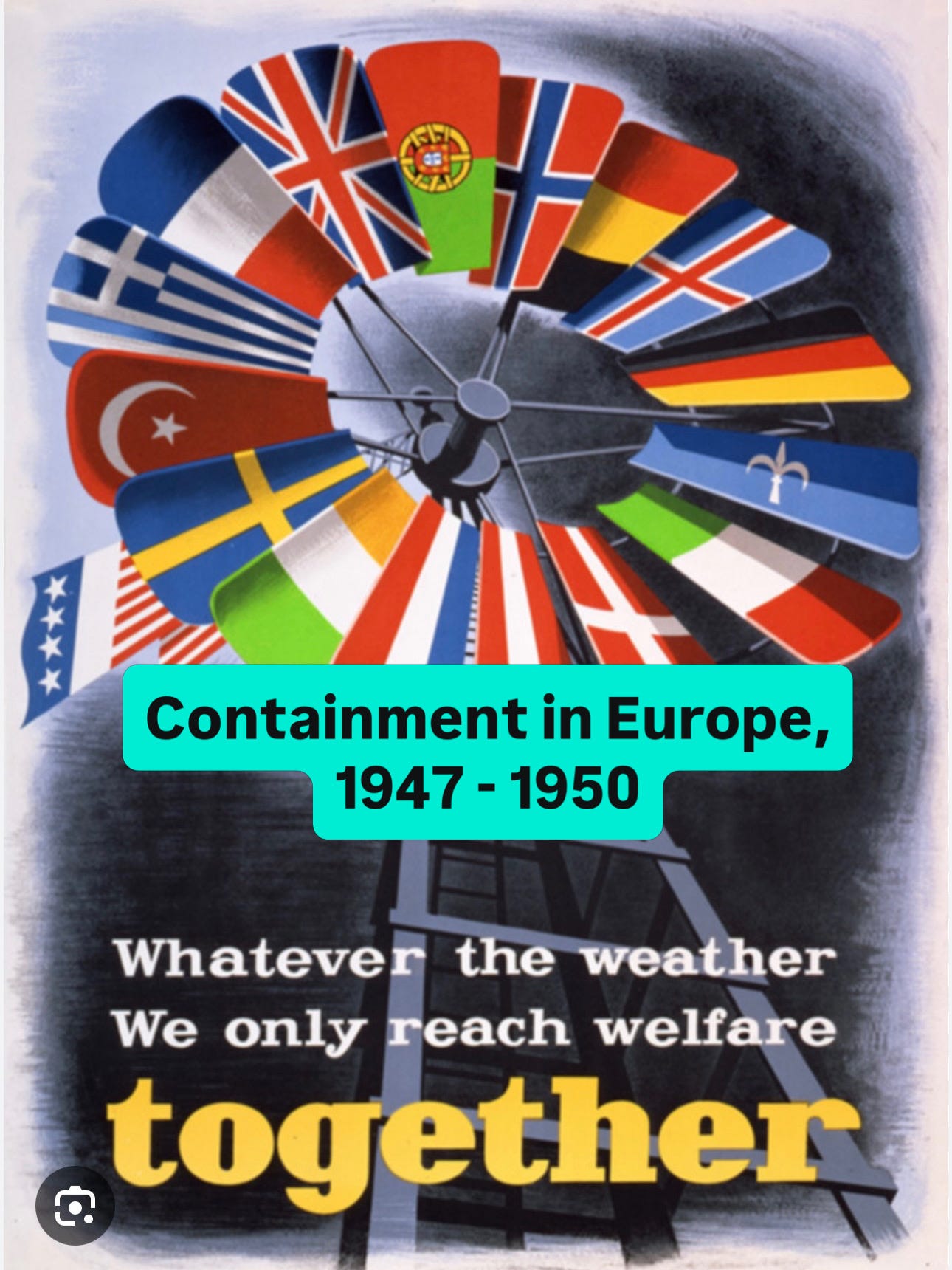
World War II left Western Europe in ruins. Winston Churchill warned that Europe had become “a rubble heap, a charnel house, a breeding ground of pestilence and hate.” Churchill’s grim assessment accurately described a continent that only a few years before had dominated the globe. Economic weakness threatened political instability making Europe vulnerable to Soviet influence. For example, the Communist Party enjoyed growing support among unemployed workers in France and Italy.
The Marshall Plan
Secretary of State George Marshall recognized the crisis and convinced President Truman that the United States had to act quickly. Speaking at Harvard University in June 1947, he proposed a bold plan to offer massive economic aid to help reconstruct Europe.
The Marshall Plan committed $13 billion (the equivalent of $200 billion in 2026) to help rebuild 16 Western European countries. The desperately needed funds helped these nations stage a remarkable economic recovery. Within four years, industrial production within the region reached a level 41 percent higher than it had been on the eve of World War II. The Marshall Plan thus achieved its twin goals of rebuilding Western Europe and containing Communism.
The Berlin Blockade
Although the Marshall Plan proved to be a great success, it did not reduce tensions between the United States and the Soviet Union. In 1948 the city of Berlin suddenly became the focus of the first great test of wills between the rival superpowers.
At the end of World War II, the Allies divided Germany into separate occupation zones that became known as West and East Germany. As Germany’s largest city and former capital, Berlin had a tremendous political and psychological significance. The Allies recognized this fact when they divided Berlin into four separate zones controlled by the United States, Britain, France, and the Soviet Union. However, the city of Berlin lay 110 miles inside East Germany.
Stalin increasingly viewed the presence of the Western powers in Berlin as an unacceptable obstacle to his plan to dominate East Germany. On June 24, 1948, he ordered troops to blockade all the roads, rail lines, and canals linking the city to West Germany. Stalin knew that the vulnerable and now isolated city only had a 30-day supply of food to feed its population of 2.2 million people. He believed the blockade would convincingly demonstrate that the United States had neither the power nor the will to support Berlin.
“We’re going to stay, period!”
President Truman understood that the Berlin Blockade represented a direct challenge to America’s new policy of containment. He rejected the options of ordering a discreet withdrawal or using military force to provoke a direct confrontation. Recognizing that the Berlin Blockade represented a crucial test of American resolve, Truman forcefully declared, “We are going to stay, period!”
The Berlin Airlift
Truman surprised Stalin by choosing to supply West Berlin by air. Although this risky strategy avoided a military confrontation, it required a massive and unprecedented airlift to supply the 4,500 tons of food, coal, and medicine the people of West Berlin needed every day.
The Berlin Airlift proved to be an inspiring success. American, British, and French aviators flew 277,804 missions and delivered 2.3 million tons of supplies in just 321 days. In addition, American pilots raised the spirits of West Berlin children by parachuting thousands of toys and candy bars.
Stalin soon realized he had been outwitted. The constant roar of planes over Berlin provided a vivid demonstration of American determination. The crisis changed the relationship between Germany and the Western Allies from that of occupiers and occupied to partners in a joint struggle to defend the Free World. Faced with these strategic and psychological realities, Stalin lifted the blockade on May 12, 1949.
The airlift underscored Berlin’s importance as a visible symbol of the Cold War in Europe. In 1961, the Soviets surrounded the city with a 28-mile concrete wall, designed to prevent East Germans from escaping to freedom in West Berlin. The Berlin Wall quickly became the supreme symbol of the Iron Curtain in Europe.
Rival Alliances
The Berlin Airlift convinced American leaders of the need to organize an alliance to protect Western Europe against possible Soviet aggression. On April 4, 1949, ten European countries joined the United States and Canada to sign the North Atlantic Treaty Organization (NATO). The pact operated on the principle of COLLECTIVE SERCURITY. Article 5 stipulated “an armed attack against one or more of the signatories in Europe or North America shall be considered an attack against them all.”
America’s decision to join a peacetime alliance based on collective security marked a decisive break from the country’s long-standing isolationist past. The Truman administration thus positioned the United States as a superpower, ready to accept its global responsibilities.
The Soviet Union did not view NATO as a defensive alliance. Instead, its leaders criticized NATO as an example of how American’s demand for new markets and additional raw materials turned it into an expansionist power, threatening Soviet security. In 1955, the Soviets responded by forming a rival military alliance with their Eastern European satellites called the Warsaw Pact. Two hostile military alliances now confronted each other across a tense and divided Europe.
So why should you remember Cold War events in Europe between 1947 and 1950. The Marshall Plan, Berlin Airlift, and NATO have all generated sets of multiple-choice questions. In addition, pivotal Cold War events in Europe are key parts of SAQ and LEQ questions asking students to interpret the origins of the Cold War.