



During the Era of Good Feelings (1817 – 1825), most American families produced goods for local markets. However, between 1825 and 1860 revolutionary changes in transportation and manufacturing created a MARKET REVOLUTION that caused a dramatic increase in productivity, trade, and commerce. As America started to industrialize, home production shifted to workshops and factories. Within a short time, more and more Americans began producing goods for regional and even national markets.
The Market Revolution brought substantial and growing prosperity to a rising number of middle-class families. The decline of the household as a focus of production led directly to the emergence of new ideas about the proper role of husbands and wives.
The Doctrine of Separate Spheres
The Constitution did not change the legal status of American women. However, the new American republic’s need for well-informed citizens and virtuous public officials helped give rise to a new ideal for American wives that historians now call REPUBLICAN MOTHERHOOD. According to its advocates republican mothers had the responsibility to become exemplary parents who would raise their children to uphold the ideals of the new republic.
During the antebellum period the earlier ideal of republican motherhood gradually evolved into a new cultural ideal known as the CULT OF DOMESTICITY. This set of beliefs envisioned separate spheres of activities and responsibilities for men and women.
“True Men” were expected to aggressively pursue wealth and power in the ruthlessly competitive public worlds of business and politics. In contrast, “True Women” were expected to devote their energies to creating a stable and peaceful home. As a nurturing mother and faithful spouse, the wife created a home that was a “haven in a heartless world.” The home thus became a refuge, and the wife became what one popular woman’s magazine called “the light of the house.”
Godey’s Lady Book
During the antebellum years, women’s magazines reached a national audience of middle-and-upper class women. These magazines contained no references to politics, controversial issues, or religious disputes. Instead, they presented their readers with features about the newest fashions and commentaries that reinforced aspects of the cult of domesticity.
Godey’s Lady Book emerged as America’s leading women’s magazine. During the 1850s over 150,000 subscribers looked forward to the arrival of the magazine’s monthly issue. Each 90 –100 page edition devoted at least one-fourth of its pages to illustrating fashionable evening dresses, bonnets, and children’s wardrobes.
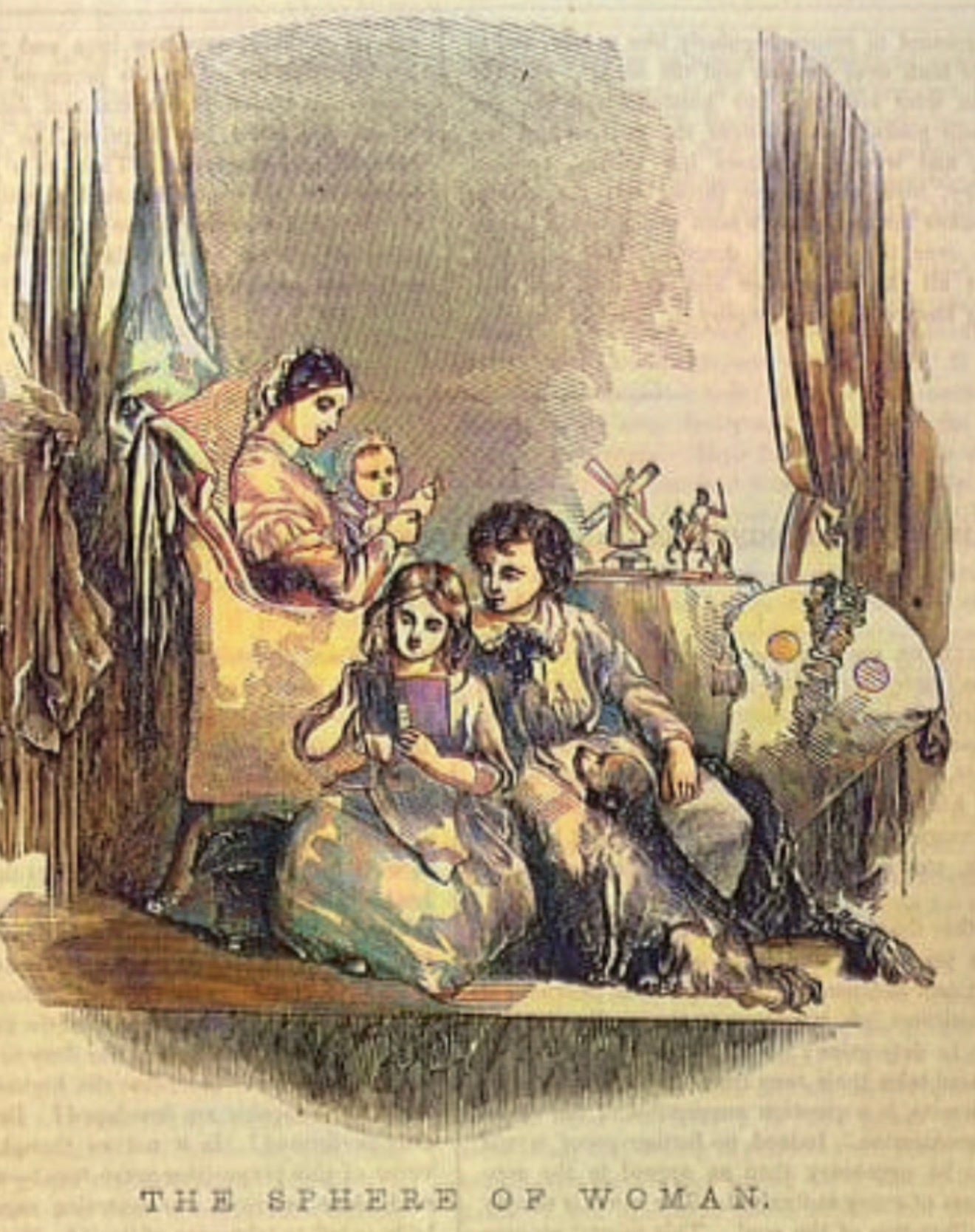
The magazine also included engravings like the one featured below. Titled “The Sphere of Woman” the image underscored Godey’s mission “to make females better acquainted with their destinies and privileges.”
The scene in “The Sphere of Woman” is set entirely within a secure interior inside a comfortable refined home. As the moral center of her home, the mother oversees the education and ethical development of her children. The young daughter occupies a central position, prefiguring her future role as the head of her own family.
An Unreachable Ideal
The great majority of American women could never hope to achieve the lifestyle portrayed in the Godey engraving. Only white women of European descent could become “True Women.” For immigrant women, the wives and daughters of farmers, women who followed their husbands to the frontier, and enslaved African women working on cotton plantations the necessities of daily life overshadowed the niceties enjoyed by affluent families.
So why should you remember the cult of domesticity?
The Cult of Domesticity is one of the most frequently tested APUSH concepts. Multiple-choice sets often feature a passage by Catherine E. Beecher explaining the importance of a woman’s dominant role in the private sphere. For example, Beecher stressed that women should be the primary educators of the nation’s children. It is important to point out that delegates to the Seneca Falls Convention would have opposed Beecher’s ideas about the subordinate role of women.
The Cult of Domesticity has also played a role in SAQ and DBQ questions. For example, one of the documents in the 2026 DBQ featured the Godey engraving featured above. And finally, the cultural ideas of the Cult of Domesticity did not disappear. They experienced a major revival in America’s post-World War II suburbs.