


Is it possible for an event that didn’t happen to have major consequences and become part of a frequent set of APUSH exam questions? Surprisingly, the answer is yes! Let me explain:
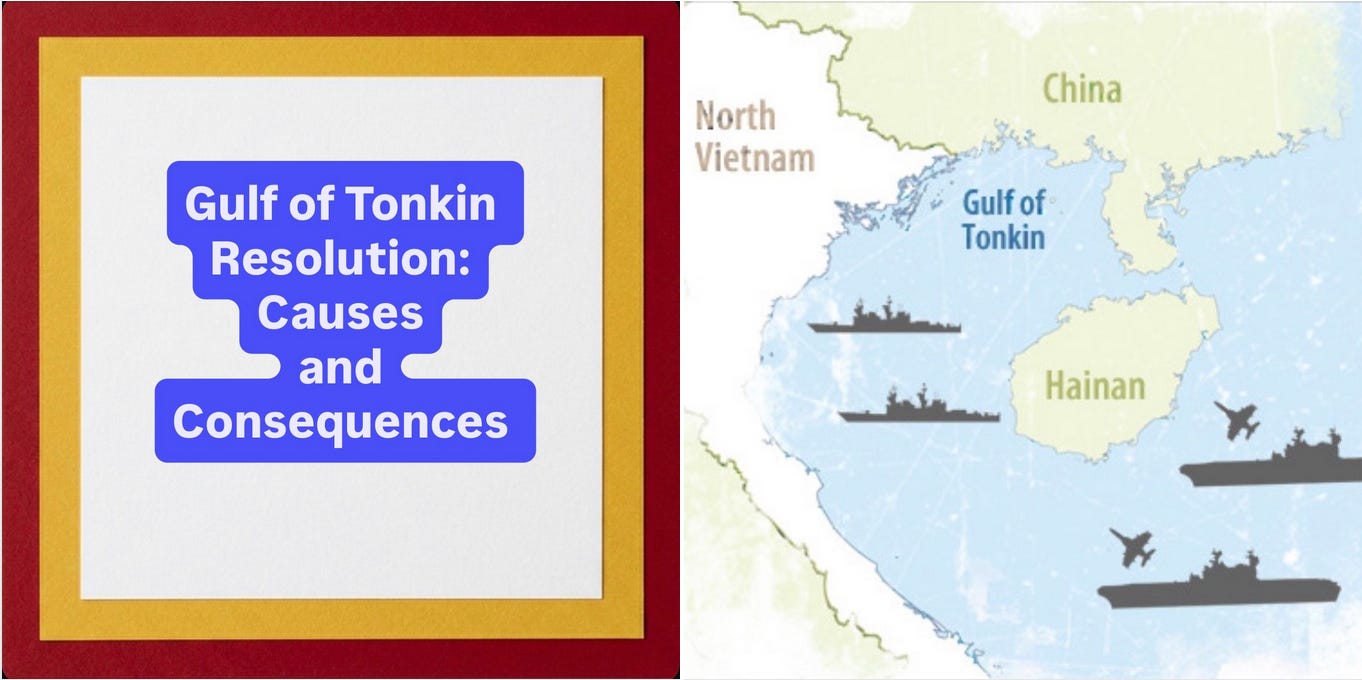
In early August 1964, U.S. Navy warships and South Vietnamese gunboats began conducting intelligence gathering operations in the Gulf of Tonkin along the coast of North Vietnam. On August 4th, two American destroyers reported that small but swift North Vietnamese torpedo boats fired at them. The U.S. warships took evasive actions while wildly firing in all directions. The commander of one of the destroyers soon radioed that there had been no actual visual sightings of enemy ships. He tentatively concluded that the alleged contact may have been due to a combination of an unusually dark night and “freak weather” conditions that adversely affected the ship’s sonar and radar.
Although what happened remained unclear, President Johnson told a nationally televised audience that “hostile actions against United States ships” forced him to respond to North Vietnamese aggression. Even as he spoke, 64 Crusader jets struck 4 North Vietnamese patrol boat bases and a major oil storage depot. President Johnson assured the American public that his swift military action had been “limited and fitting” and that the United States would “seek no wider war.”
The Gulf of Tonkin Resolution
The next day, Johnson asked Congress to pass a resolution authorizing him to take “all necessary measures to repel any armed attack against the forces of the United States and to prevent further aggression.” Congress and the American public were not told about the secret raids on North Vietnam or the new evidence that an attack may not have occurred. Unaware of this information, the House unanimously supported the Gulf of Tonkin Resolution while only two senators opposed it.
Johnson’s deft handling of the Gulf of Tonkin affair seemed to be a major political success. The Gulf of Tonkin Resolution sent a clear signal to North Vietnam that America would defend South Vietnam. Opinion polls showed that 72 percent of the public supported LBJ’s forceful but measured actions. Very few people listened when Senator Wayne Morse warned, “We are in effect giving the President warmaking powers in the absence of a declaration of war. I believe this to be a historic mistake.”
A “blank check”
The Gulf of Tonkin Resolution gave President Johnson a “blank check” to fight a full-scale war without a formal Congressional declaration of war. In March 1965 he took the fateful step of ordering the first U.S. Marines to land in South Vietnam. By the end of the year, 180,000 additional combat soldiers poured into the country.
Johnson’s dramatic escalation transformed a localized guerrilla conflict into a massive, years-long military commitment. By the end of 1967, about 500,000 American soldiers guarded South Vietnam’s cities and patrolled its rice paddies. Search-and-destroy missions killed over 200,000 enemy soldiers but left one-fourth of the people in South Vietnam homeless. Known as the Viet Cong, the South Vietnamese communists struck back with deadly ambushes and hidden booby traps. About 16,000 American soldiers lost their lives between 1965 and 1967.
Credibility Gap
The rising American casualties contradicted the Johnson administration’s optimistic reports. Public skepticism about the war created a widening “credibility gap.” The gap deepened as evidence surfaced that the August 4th “attack” in the Gulf of Tonkin probably did not occur. An ever growing number of people concluded that the war had in fact been launched on a lie.
Hawks versus Doves
When President Johnon escalated the war about two thirds of the public approved his decision. “I don’t like being over here,” wrote one marine, “But I am doing a job that must be done. Supporters of the war agreed. Known as “hawks”, they argued that America was fighting a just cause to defend the freedom of South Vietnam. Without American help, South Vietnam would fall and the communists would eventually take over Southeast Asia.
When the war did not quickly end, a growing number of people began to question America’s involvement in Vietnam. Known as “doves,” these critics argued the United States could not win a guerrilla war in Asia. The tragic loss of life was too great. Instead of saving South Vietnam, American bombs were destroying it. The dollars spent in Vietnam would be better spent funding Great Society programs.
The increasingly bitter debate between the hawks and doves polarized American society. A deeply ambivalent housewife expressed the public’s frustrations when she told an interviewer, “I want to get out, but I don’t want to give up.”
So why should you remember the causes and consequences of the Gulf of Tonkin Resolution. The resolution set in motion a series of far-reaching military, political, and social consequences. APUSH test writers expect students to know that America became involved in Vietnam to fulfill its commitment to contain communist expansion. Multiple-choice questions often use political cartoons to illustrate the growing public debate between hawks and doves over the merits and rationale for the Vietnam War. Short-answer questions expect students to know that the Vietnam War led to massive anti-war protests. A series of prompts by the Students for a Democratic Society (SDS) express the disillusionment of a growing number of young Americans with the Vietnam War.