


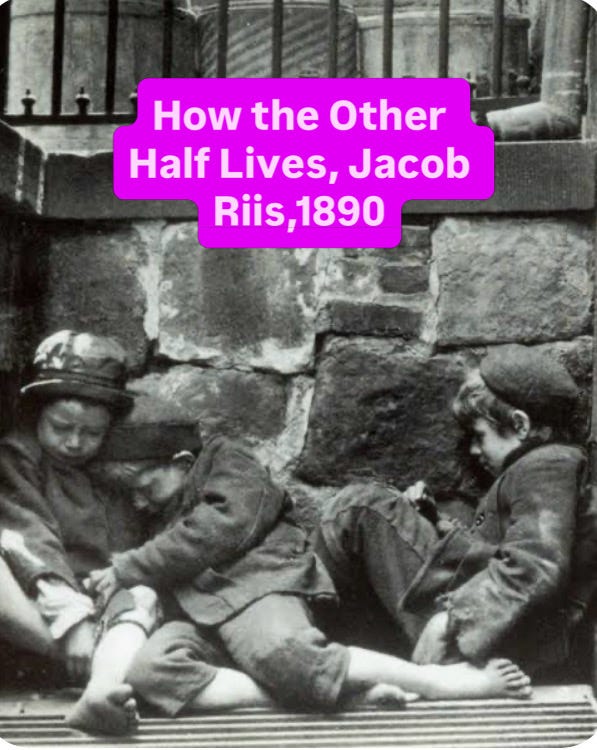
In 1890, New York City provided visible evidence of the triumphs and tragedies created by the industrial revolution transforming American society. Wealthy captains of industry lived in extravagant mansions lining Fifth Avenue. Preoccupied with enjoying their lavish lifestyle, they had little knowledge of the growing concentration of immigrants living in the city’s Lower East Side. Their lack of awareness changed when Jacob Riis published his eye-opening book How the Other Half Lives.
Riis understood how poverty’s sharp edge created a sense of overwhelming despair. After immigrating from Denmark in 1870, Riis lived in one of New York City’s dark, overcrowded tenement buildings. Unwilling to accept defeat, he taught himself how to use the recent invention of flash photography. As a police reporter for the New York Tribune, Riis filed frequent reports about life in the city’s Lower East Side.
Riis used his pioneering photographic skills to reveal the reality of conditions “more terrible than words can tell.” His black-and-white images captured the daily grind of poverty in tenements, streets, and alleys he described as “the evil offspring of public neglect and private greed.” Riis’s poignant photographs of children like the one featured in this post, opened New Yorker’s eyes to a world they had previously ignored.
In 1890, Riis compiled his photographs and graphic commentaries into an influential book titled How the Other Half Lives. This powerful work galvanized a new generation of Progressive reformers to demand more rigorous building inspections and slum clearance projects. For example, Riis’s book directly spurred new sanitation, lighting, and safety laws.
How the Other Half Lives did more than change laws in New York City. By showcasing the grim realities of immigrant life, Riis helped spark the beginning of the Muckraker movement in America journalism. Soon other reform-minded authors exposed unsanitary conditions in food-processing plants, examples of corporate greed, and corruption by political bosses.
So why should you remember Jacob Riis and How the Other Half Lives? APUSH multiple-choice questions have featured passages and photographs from Riis’s book. Test writers expect APUSH students to know that industrialization, urbanization, and immigration combined to create the conditions documented by Riis. They particularly emphasize the key point that Riis’s compelling images contributed to an increase in Progressive reform activity while also fueling the rise of muckraking journalism.