


TOBACCO and SLAVERY in COLONIAL VIRGINA
PART I
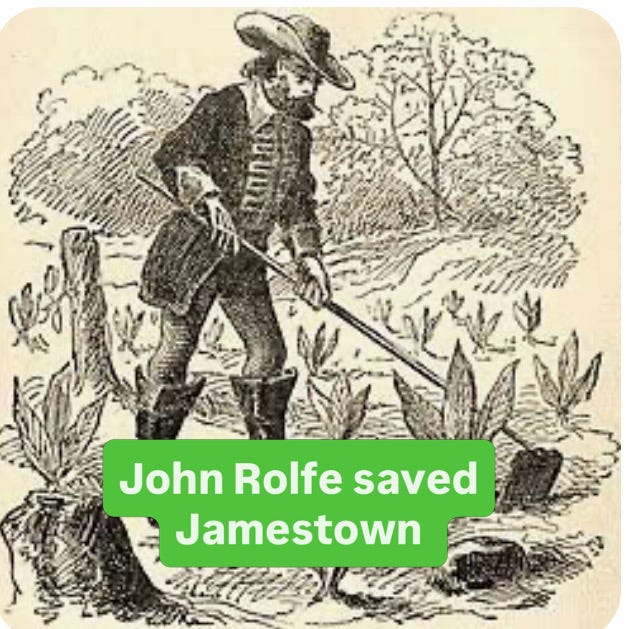
JOHN ROLFE SAVED JAMESTOWN
In early 1623, Richard Frethorne sent this urgent message to his parents describing the desperate conditions he faced in the Jamestown colony: “There is nothing to be gotten here but sickness and death.” Frethorne concluded by begging his father, “do not forget me, but have mercy and pity my miserable case.”
Frethorne died shortly after sending this letter. His tragic fate was typical of the early settlers in the Jamestown. During the colony’s first 15 years, disease, malnutrition, and conflicts with the Native Americans claimed the lives of as many as 80 percent of the first 10,000 colonists.
An uncertain beginning
The Virginia Company founded Jamestown as a joint-stock venture to make a profit for its investors. But Jamestown began as an unprofitable disaster. Rather than cultivate corn, the first colonists spent their time in a futile search for gold and silver. As a result, the colony teetered on the brink of collapse.
John Rolfe and the “Golden Leaf”
Jamestown’s struggling colonists desperately needed a cash crop. John Rolfe saved the colony when he learned how to cultivate a sweet form of tobacco. The new variety thrived in Virginia’s long growing season and rich Tidewater soil.
Tobacco quickly commanded a seemingly inexhaustible market in England and in Europe. Jamestown’s “Golden Leaf” sold for about 5 to 10 times as much as it cost planters to produce. Given this financial incentive, tobacco production soared from just 2,000 pounds in 1624 to 1,200,000 pounds in 1629.
A labor-intensive crop
Tobacco is a labor-intensive crop. Each step from planting seeds to loading barrels of cured leaves onto cargo ships required exhausting manual labor. Grueling tasks included weeding the area around each plant, removing worms, and topping off the plants to promote the growth of lower leaves.
Indentured servants
At first, tobacco planters relied upon indentured servants like Richard Frethorne. Thousands of hungry and homeless young men and women faced a bleak future in England. Too poor to afford the 6-pound cost of a transatlantic voyage, they became indentured servants who agreed to work on tobacco plantations for 4 to 7 years in return for their passage to Virginia.
The push of unemployment in England combined with the pull of opportunity in Virgina to draw a large number of indentured servants to Tidewater tobacco plantations. During the17th century, indentured servants comprised about 90,000 of the 120,000 people who journeyed to Virginia.
The first African slaves
Planters began the limited purchase of African slaves in 1619. However, enslaved Africans were a very expensive investment. Few laborers, either indentured servants or enslaved Africans, survived more than five years in Virginia’s harsh working and living conditions. As a result, in 1650 enslaved Africans comprised just 2 percent of Virginia’s population. But unforeseen events would cause this figure to dramatically increase.
So why should you remember the role of indentured servants and tobacco in colonial Jamestown? Indentured servants were an important but often forgotten factor in Jamestown’s early history. For example, they can be used to illustrate an important population movement during the seventeenth century. In addition, one APUSH passage used an excerpt from Richard Frethorne’s letter as a prompt to highlight the need for inexpensive labor and the growing tension between independent farmers and their indentured servants.