


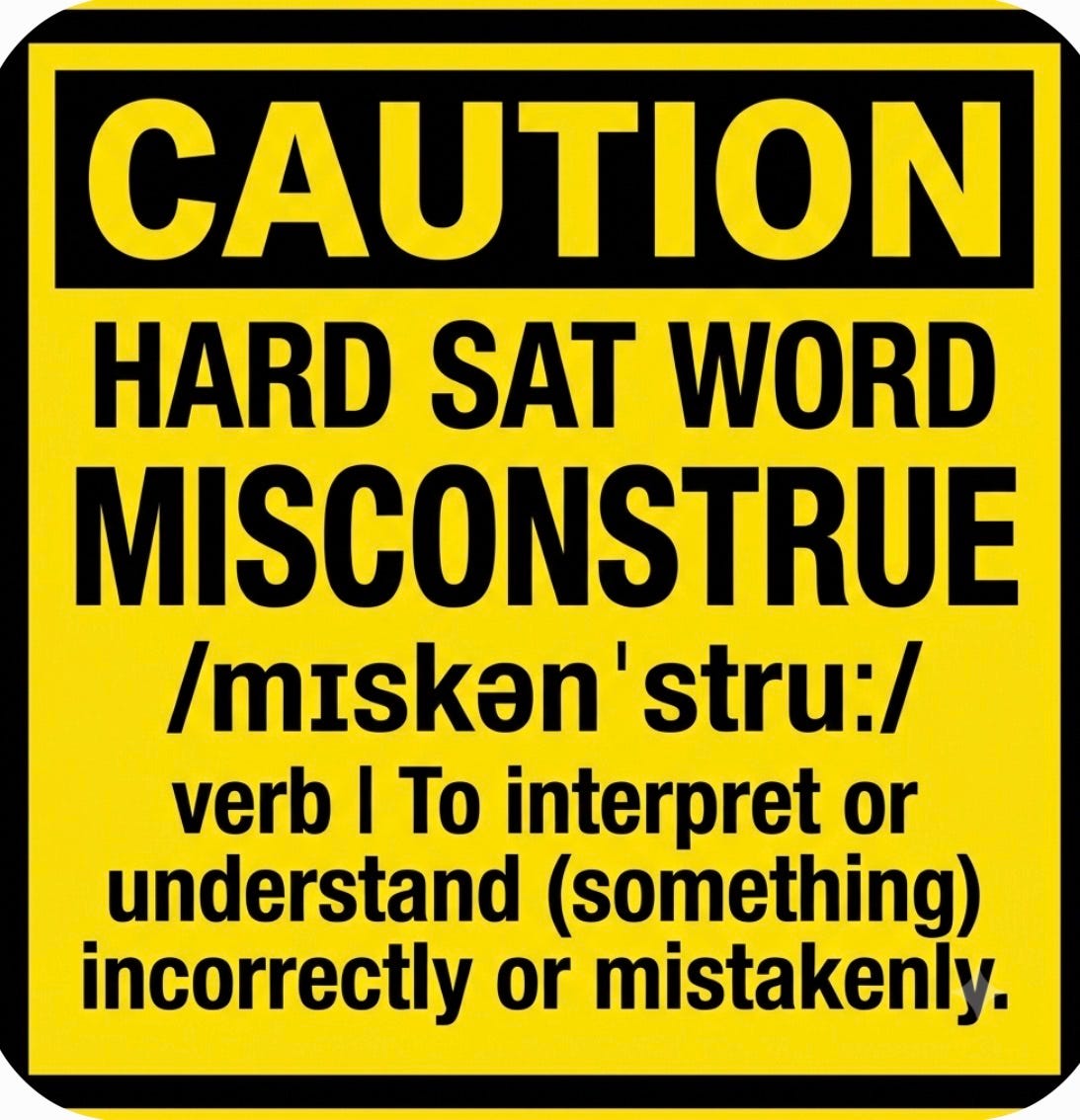
CAUTION – MISCONSTRUE is a very easy word to MISCONSTRUE! Let’s take a close look at this challenging word:
MISCONSTRUE means to misunderstand or misinterpret. For example, in their classic song “Tearin’ Up My Heart,” NSYNC doesn’t want their feelings for a girl to be MISCONSTRUED. They try to eliminate any confusion by warning her, “Don’t misunderstand what I’m tryin’ to tell you…It feels like we’re runnin’ out of time.”
Unfortunately, SAT test writers have shown little interest in using the emotional struggles of Boy Bands to illustrate challenging SAT vocabulary words. But they are very interested in using MISCONSTRUE as BOTH a correct and a tempting incorrect answer in difficult vocabulary in context questions.
Yuen Yuen Ang is a political scientist who has carefully studied the massive increase in the number of Chinese patents. She warns that the quantity of their patents should not be MISCONSTRUED or misinterpreted as a leading indicator of the quality of Chinese technological innovations.
Now let’s turn to a particularly difficult question that led to a dispute between students who chose MISCONSTRUE and those who selected EFFACE. The passage begins by pointing out that modern historians are increasingly using quantitative analysis of “vast historical data sets” to examine broad social forces. OK, but does this method MISCONSTRUE or EFFACE and thus erase what the passage calls “the particularity of individual actors.” Many students argued that historians using this approach MISCONSTRUE the importance of individuals. Although MISCONSTRUE is a very tempting answer, the method’s reliance on data sets and “other tools of abstraction” actually EFFACES or erases and thus makes individuals unnoticeable.
So watch out! MISCONSTRUE can be a correct answer. But, it can also be used as a very tempting wrong answer!!
MISCONSTRUE – to misunderstand or misinterpret
EFFACE – to erase and thus make something unnoticeable