


On June 7, 1892, Homer Plessy bought a train ticket from New Orleans to Covington, Louisiana. Plessy was born a free man and was known to have had a black great-grandmother. Although he was seven-eighths Caucasian, Plessy was classified as black under Louisiana’s Separate Cars Law and thus required to sit in a “colored car.” But Plessy deliberately defied the law by sitting in the whites-only car. A detective immediately arrested Plessy when he refused to move to the “colored car.”
Supported by a New Orleans Citizens Committee, Plessy sued the railroad arguing that segregation was illegal under the Fourteenth Amendment’s clause forbidding a State from denying “any person within its jurisdiction the equal protection of the law.” However, Judge John H. Ferguson of New Orleans ruled against Plessy. When the Louisiana Supreme Court upheld Ferguson’s decision, the Citizens Committee appealed the case to the United States Supreme Court.
Plessy’s legal team argued that the Separate Car Act placed an unnecessary and unjust “badge of inferiority” on African Americans. They asked the Supreme Court justices to consider how they would react if the legal tables were turned and they had to sit in a segregated car. They forcefully emphasized that, “Justice is pictured blind and her daughter, the Law, ought to at least be color=blind.” Unmoved by these arguments, the Supreme Court ruled against Plessy by a 7 to 1 vote. The Court’s decision upheld racial segregation by approving “separate by equal” railroad facilities for African Americans.
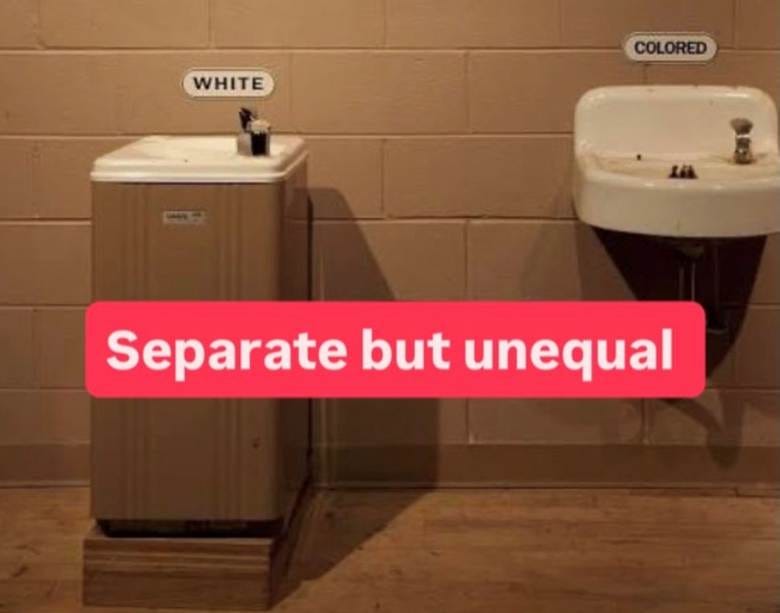
So why should you remember Plessy v. Ferguson? The Plessy decision had fateful consequences for race relations in the United States. It allowed Jim Crow segregation laws to spread across the South. Soon there were segregated schools, restaurants, and hotels. Ubiquitous signs saying “White Only” or “Colored” appeared on restroom doors, above water fountains, and inside stores. Although this facilitated sectional healing, it denied the promise of justice to African Americans. The legal doctrine of “separate but equal” remained in effect until the Supreme Court’s landmark 1954 decision in Brown v. Board of Education of Topeka unanimously ruled that “separate” is inherently unequal.