


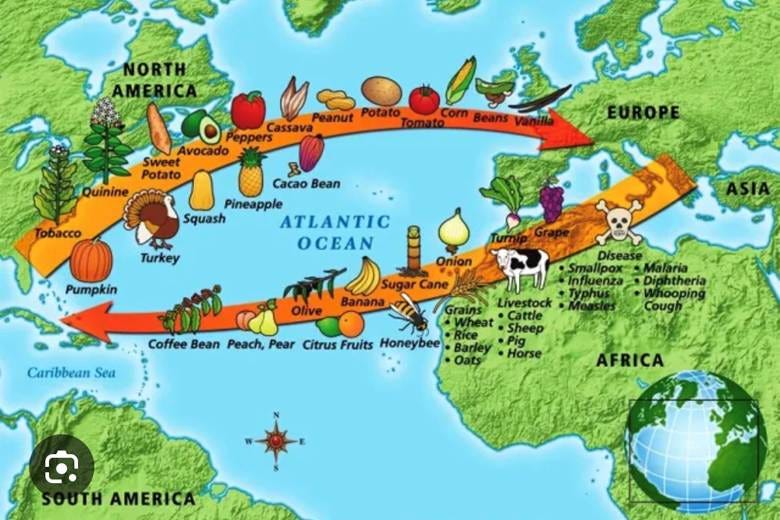
In 1491 no one in Ireland had ever seen a potato, no one in Italy had ever tasted a tomato, and no one in Switzerland had ever eaten a chocolate. At the same time, no one in the Americas had ever ridden a horse, roasted a chicken, or enjoyed the sweet taste of sugar. Columbus’s voyage launched a momentous but unplanned process that forever altered diets and lives in the New and Old Worlds. The Columbian Exchange refers to the exchange of plants, animals, peoples, and diseases between the New World, Europe, and Africa.
The Columbian Exchange is an APUSH Period 1 superstar that regularly appears on multiple-choice questions. APUSH test writers will not ask you to identify the formal definition of the Columbian Exchange. But they will ask you to identify the characteristics of this pattern of exchange from a descriptive excerpt written by a modern historian.
Question sets on the Columbian Exchange typically include questions testing your knowledge of the profound changes it brought to Native Americans, Europeans, West Africans, and colonists living in South Carolina, and Pennsylvania.
Impact on Native Americans
European sailors and soldiers carried invisible but deadly viruses and microbes. Within a short time, smallpox, measles, and cholera decimated once thriving Native American populations. Demographers estimate that 40 to 100 million people lived in the Americas in 1491. This figure plummeted to an estimated 8 million people in 1600. The sudden collapse of entire New World communities enabled European colonists to more easily gain control over Native American lands.
Impact on Europeans
New World foods and precious metals had a dramatic and long-lasting impact on Europe. Nutritious American foods fueled a surge in European population. At the same time, the influx of gold and silver facilitated economic growth. These powerful forces stimulated the rising prosperity of the merchant class in Western Europe. This supported a historic shift from a stagnant feudal economy to a new and more dynamic capitalist economy.
Impact on West Africans
The Spanish quickly discovered that coffee and sugar flourished on Caribbean Islands and the Brazilian coast. These highly prized crops produced great profits but required a large labor force. The sudden collapse of the Native American population forced the Spanish to look to West Africa for labor. Between the sixteenth and nineteenth centuries, European slave traders forcibly transplanted over 12 million West Africans to the Americas.
Impact on colonists in South Carolina and Pennsylvania
African and European foods played a significant role in the success of British colonies in South Carolina and Pennsylvania. West African women brought their sophisticated knowledge of rice cultivation to prosperous plantations in coastal South Carolina. At the same time, the rapid growth of Pennsylvania depended upon the colony’s ability to export wheat, barley, and other cereal crops to the Caribbean islands.
So why should you remember the Columbian Exchange? A significant number of Period 1 multiple choice questions will ask you to identify consequences of the Columbian Exchange. It is especially important to remember that European colonists introduced deadly epidemics that decimated Native American communities. In addition, the Columbian Exchange can provide especially pertinent examples for answering LEQ questions that ask about the growth and extent of transatlantic trade.