


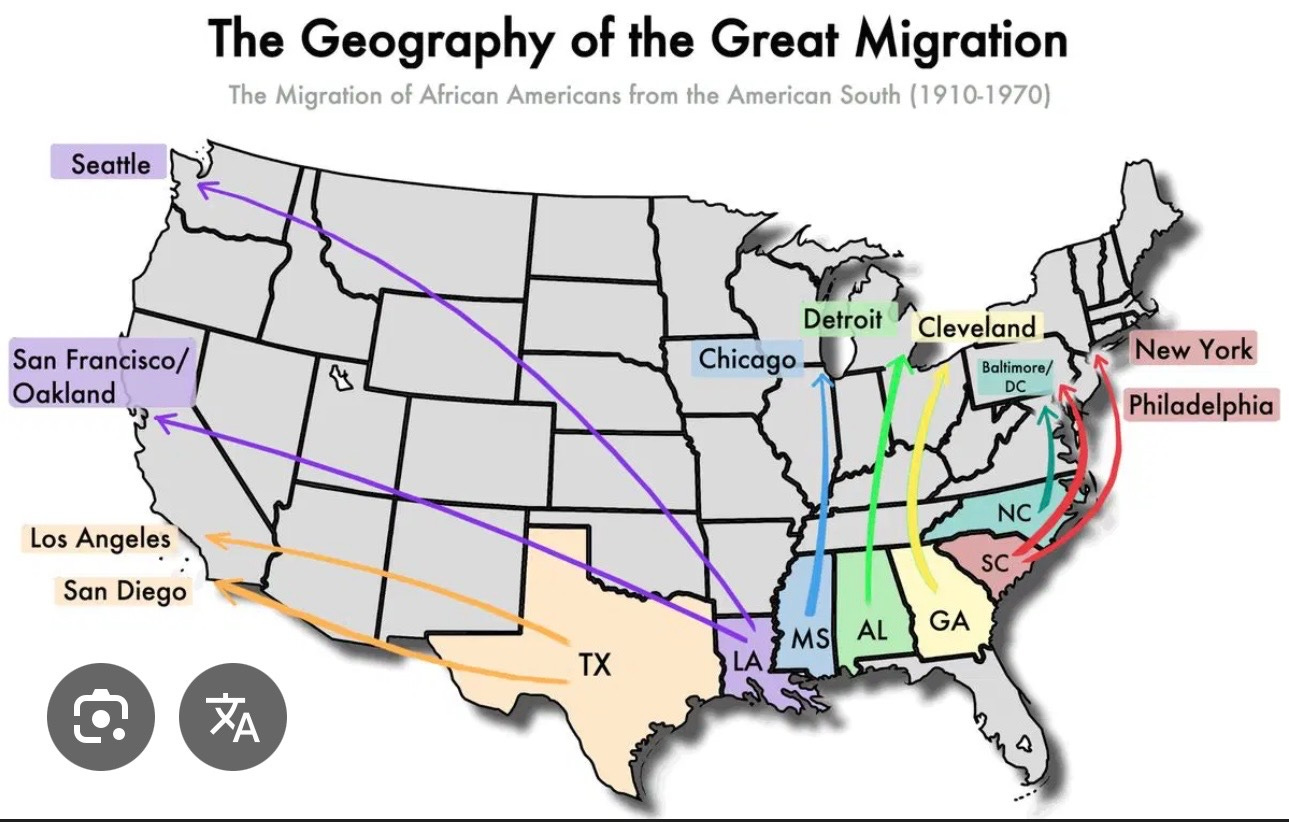
THE GREAT MIGRATION, 1910 - 1970
Normally a trip to a local grocery store should be a routine event. But in the Jim Crow era in Alabama a simple walk to the grocery store could be fraught with danger. Charles Gratton later recalled his mother’s stern warning: “Son, if you pass any white people on your way, you get off the sidewalk. Give them the sidewalk. You move over. Don’t challenge white people.”
The mother’s warning accurately reflected the reality of black life in the Jim Crow South. During the early 1900s, the “equal protection under the law” promised by the Fourteenth Amendment did not exist. Instead, African Americans faced legal, economic, political, and social discrimination reinforced by the pervasive threat of violence. Any violation of segregation customs could result in swift and often brutal punishment.
Leaving the Land of Cotton
In 1900, nine of every ten black Americans lived in the South, and three out of four lived on farms. The relentless humiliation of Jim Crow segregation crushed the brief spirit of optimism during Reconstruction. Grinding poverty and the Ku Klux Klan’s campaign of intimidation and violence provided compelling reasons for Southern blacks to leave their homes.
The outbreak of World War I offered Southern blacks the opportunity for a better life in the North. The war cut the flow of European immigrants who had previously worked in Northern factories. Faced with a critical shortage of labor, Northern industrialists offered Southern blacks jobs working in Pittsburgh steel mills, Chicago meatpacking companies, and New York garment centers.
The push of discrimination and the pull of a booming Northern job market convinced about 1.5 million African Americans to leave the South in the years between 1910 and 1930. This became the first phase of a mass movement of African Americans from the rural South to cities in the North and Midwest that is known as the Great Migration.
“The Greatest Negro City in the World”
The Great Migration fostered the growth of a new urban African American culture. During the 1920s, a creative generation of Black writers and artists transformed Manhattan’s Harlem district into what they proudly called the “the greatest Negro city in the world.” Langston Hughes, Jean Toomer, Claude McKay, and Zora Neale Hurston formed a core group of writers who contributed to an outpouring of black literary, artistic, and political expression known as the Harlem Renaissance.
Alain Leroy Locke described the new Black pride and assertive spirit in his essay “The New Negro.” Locke explained that in the past Black Americans shared the common conditions of slavery and segregation. In contrast, Blacks living in Harlem formed the vanguard of a new common consciousness rooted in their collective racial identity. Harlem thus became the vibrant nerve center of Black America’s thrust toward “group expression and self-determination.”
The Second Great Migration
The Great Depression ended the first phase of the Great Migration. However, World War II created a shortage of jobs in industrial plants in the North and West. Southern Blacks once again turned to these regions for jobs and freedom from racial injustice. What some historians call the Second Great Migration began in 1940 and ended in 1970. During this time as many as 5 million African Americans migrated to cities outside the South.
So why should you remember the Great Migration? APUSH test writers expect you to know the factors that pushed Blacks out of the South and pulled them into cities in the North and West. The Great Migration has played a particularly important role in Short Anwer Questions and Long Essay Questions asking how economic factors influenced migration within the United States from 1910 to 1970.