


SIGMA4ESSAYS
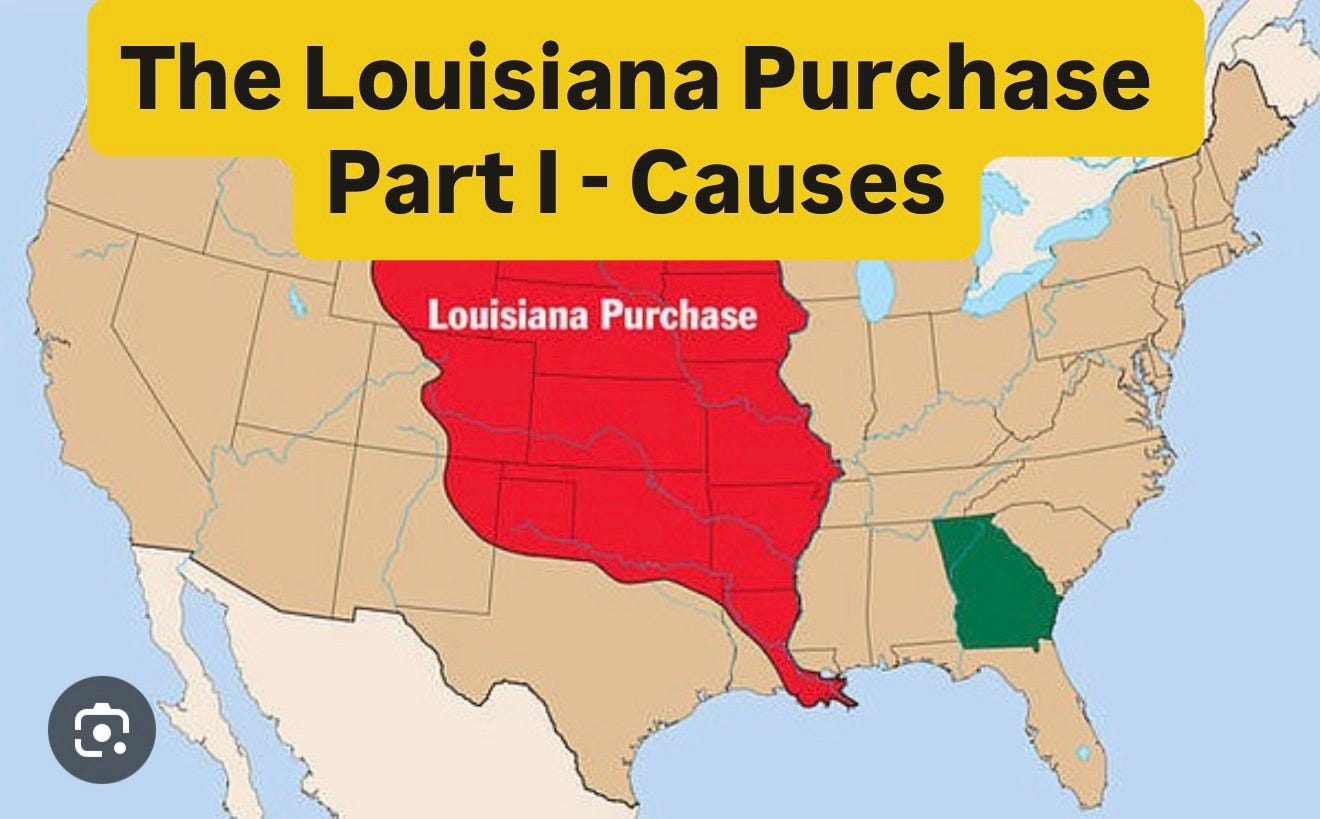
The Louisiana Purchase of 1803 stands as pivotal turning point in American history. It doubled the territorial extent of the United States and fundamentally reshaped the geographic trajectory of North America. Negotiated by the Jefferson administration and signed by Napoleonic France, the acquisition of roughly 828,000 square miles west of the Mississippi River transformed the young republic from a fragile, Atlantic facing nation into a continental power. A complex interplay of domestic economic imperatives and a surprising military revolt in the Caribbean played key roles in causing the Louisiana Purchase.
The Vital Importance of New Orleans
By the turn of the nineteenth century, thousands of American settlers had moved west of the Appalachian Mountains into the Ohio and Mississippi River valleys. For these western farmers, the Mississippi River was more than a geographic landmark; it was a vital economic lifeline. American farmers depended on the right of deposit at the Port of New Orleans to store goods for export and avoid paying expensive duties.
Under Spanish rule, this arrangement was governed by Pinckney’s Treaty (1895). However, in 1800, France and Spain secretly executed a treaty transferring the vast Louisiana territory back to France. When word of this agreement reached Washington, President Jefferson recognized the immense strategic threat. A powerful French presence at the mouth of the Mississippi could choke American commerce and force the United States into an unwanted military alliance with Great Britain. Referring to New Orleans, Jefferson famously noted that, “there is on the globe one single spot, the possessor of which is our natural and habitual enemy.”
The situation reached a crisis in October 1802, when Spanish officials in New Orleans revoked the American right of deposit. Jefferson responded by dispatching James Monroe to Paris to assist Foreign Minister Robert Livingston in negotiating an agreement to purchase New Orleans and West Florida for $10 million.
The Haitian Revolution
Now known as Haiti, the Caribbean island of Saint-Domingue played a key role as the epicenter of French wealth and commerce in North America. However, in 1791 Toussaint Louverture launched a determined revolt of enslaved Africans. Napoleon responded by dispatching a massive expedition to crush the revolution and restore slavery.
The Haitian revolutionaries refused to surrender while yellow fever decimated the French forces. Facing catastrophic losses of troops and the imminent threat of renewed war with Great Britain, Napoleon abandoned his goal of building a Western Hemisphere empire. Needing quick capital to fund his European wars, Napoleon abruptly instructed his finance minister to sell not just New Orleans but all of the Louisiana territory to the United States for $15 million.
The Constitutional Dilemma
Napoleon’s surprise offer presented Jefferson with a major constitutional dilemma. As a strict constructionist and leader of the Democratic-Republican Party, Jefferson had long argued that the federal government possessed only those powers explicitly enumerated in the U.S. Constitution. The Constitution contained no explicit provision granting the executive the authority to acquire foreign territory or incorporate foreign citizens into the Union. Jefferson initially considered proposing a constitutional amendment to authorize the purchase. However, Monroe and Livingston warned that any delay might lead Napoleon to rescind his offer.
A combination of economic benefits and an idealistic vision for America persuaded Jefferson to set aside his strict constructionist principles. The Louisiana Purchase would enable America to control the vital port of New Orleans. In addition, the purchase would double the size of the United States giving the country almost limitless room for expansion. Jefferson believed the vast new territories would help fulfill his vision of enabling America to become an agrarian republic and thus an Empire of Liberty. Fearing that the always capricious Napoleon might change his mind, Jefferson relented and the Senate overwhelmingly approved the Louisiana Purchase.
So why should you remember the Louisiana Purchase?
The Louisiana Purchase ended the French threat to New Orleans and doubled the size of the United States. It set a precedent for acquiring foreign territory and people by treaty. In addition, APUSH test writers expect students to know the crucial role that role played by the Haitian revolt.