


Is compromise always the best way to resolve a dispute? This question forced its way onto the center stage of American politics when the Missouri Territory applied for statehood as a slave state.
The Tallmadge Amendment
Missouri’s petition to become a slave state stunned and angered Northern members of Congress. Representative James Tallmadge of New York responded by introducing an amendment providing that no more slaves could be introduced into Missouri and that all children born into slavery in the state would become free at age 25.
The Tallmadge Amendment ignited a passionate debate in both houses of Congress. At that time, free state representatives in the House outnumbered those from slave states. However, the Senate was evenly but precariously divided between 11 free states and 11 slave states. As a result, the House approved the Tallmadge Amendment while the Senate rejected it.
A widening sectional divide
Before the Missouri debates, many thoughtful Southern leaders admitted that slavery was a necessary evil inherited from their colonial ancestors. But with each passing year, the South became more and more committed to a plantation economy relying on slave labor to harvest the region’s ever-expanding fields of cotton. Cotton Kingdom leaders increasingly defended slavery as a positive good. At the same time, the North was rapidly becoming a region of small independent farmers and growing urban and industrial centers.
The heated debates in Congress reflected these sectional differences. For example, Thomas Cobb of Georgia warned Tallmadge, “You have kindled a fire which all the waters of the ocean cannot put out and which only seas of blood can only extinguish.” Tallmadge refused to back down and defiantly proclaimed, “If dissolution of the Union must take place, let it be so!” These dire threats deeply concerned Secretary of State John Quincy Adams. The future President grimly predicted the debate marked, “a title page to a great tragic volume”
Henry Clay to the rescue
The intense debate over Missouri revealed the fragility of the post-War of 1812 Era of Good feelings. As emotional arguments raged back and forth, Congressional leaders turned to their Speaker, Henry Clay of Kentucky, to find middle-ground that would end the crisis.
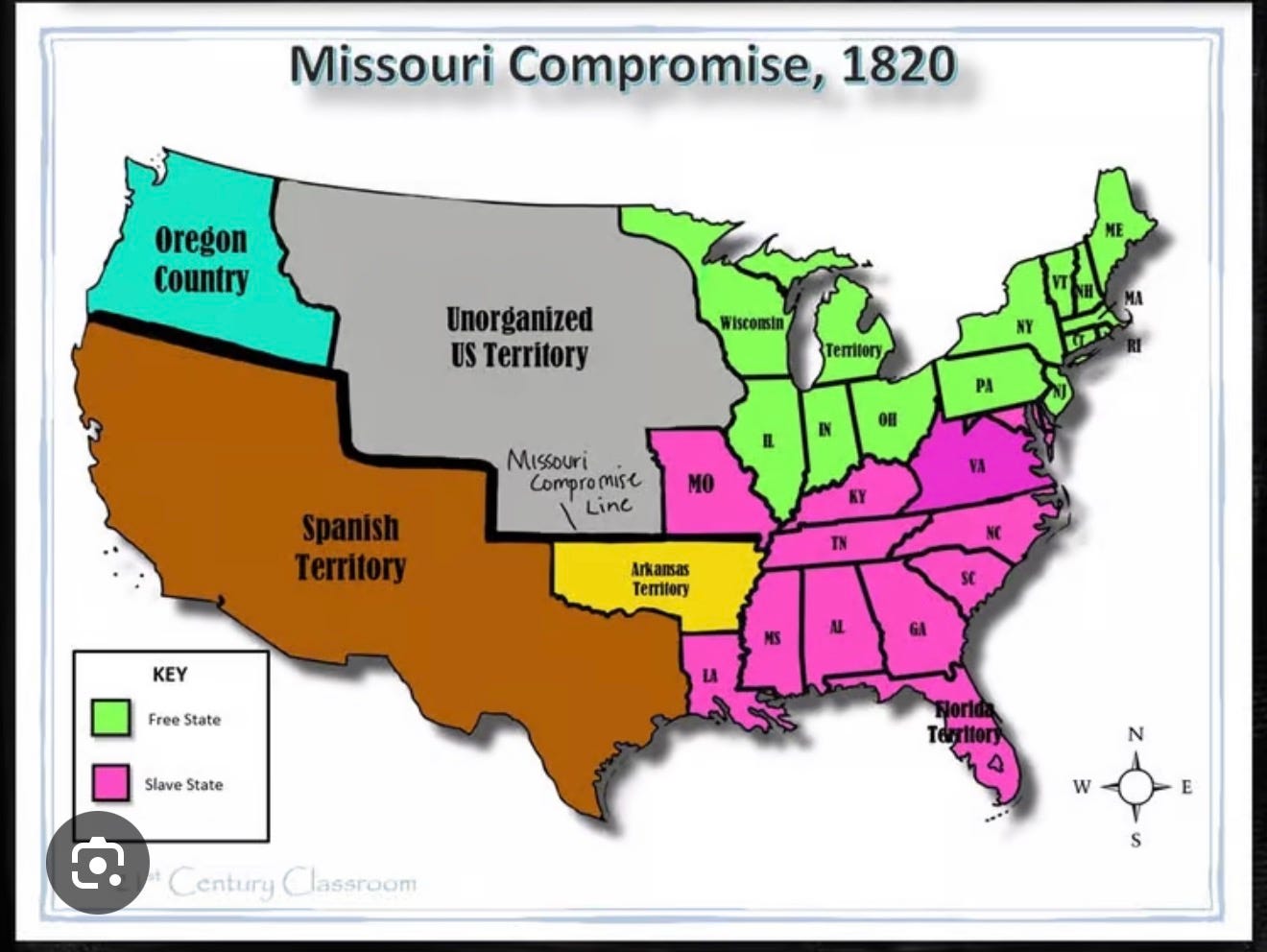
Clay proved equal to the task. Known as the Missouri Compromise, his proposal maintained the balance of power in the Senate by admitting Missouri as a slave state and Maine as a free state. As you can see in the map below, the compromise also provided that any other new states from the Louisiana Territory north of parallel 36 degrees, 30 minutes would remain free.
“A fire-bell in the night”
Both houses of Congress accepted Clay’s compromise proposals. The Missouri Compromise thus seemed to defuse the political crisis over the expansion of slavery into the western territories.
The Missouri Compromise postponed but did not resolve the status of slavery in the western territories. The debates hardened the South’s defense of slavery as a positive good essential to the region’s economy and way of life. Jefferson recognized the gravity of the situation when he likened the Missouri crisis to “a fire-bell in the night,” which “awakened and filled me with terror.” He correctly predicted that the Missouri Compromise represented “a reprieve only, not a final sentence.”
So why should you remember the Missouri Compromise?
The Missouri Compromise temporarily defused the political crisis over slavery. However, the debate foreshadowed the intersectional rivalry over slavery that dominated American political life during the 1840s and 1850s. The Congressional power struggle which finally produced the Missouri Compromise brought the South into being as a self-conscious political section. The geographic line drawn across the nation represented a permanent moral and political fissure that would inevitably deepen.