


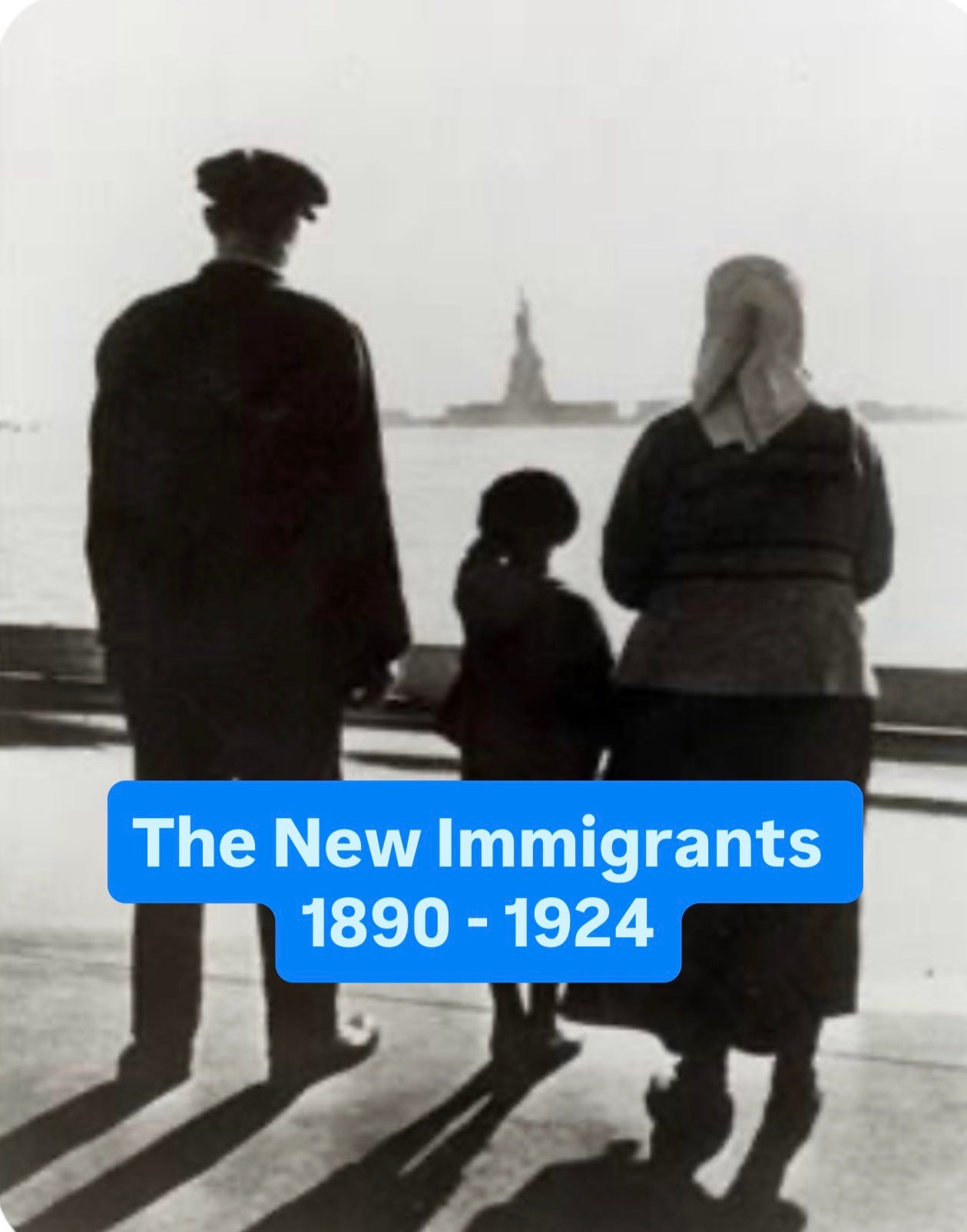
During 1907 a daily flotilla of transatlantic steamships, flying flags from a number of European nations, crisscrossed New York City’s crowded harbor. The ships did not carry raw materials or finished industrial goods. Instead, they brought thousands of newcomers, anxiously waiting for ferries to carry them to Ellis Island, America’s busiest immigration receiving station. The view of the Statue of Liberty lifting her torch of freedom filled the new arrivals with a sense of hope. At the same time, the towering office buildings of lower Manhattan filled them with a sense of apprehension.
The “huddled masses”
The “huddled masses” arriving in New York harbor in 1907 were part of a tidal wave of 20 million immigrants who settled in America between 1890 and 1924. This surge in immigration caused a dramatic change in America’s ethnic mix. Prior to the 1890s, most new Americans came from Western European countries such as England, Ireland, and Germany. But beginning in the 1890s, ethnic groups known as “new” immigrants began to arrive from countries in Southern and Eastern Europe such as Italy, Poland, and Russia. The overwhelming majority of the new immigrants practiced the Roman Catholic and Jewish faiths.
The new immigrants fled violent religious persecution, oppressive government, and hopeless poverty. Pushed by intolerance and hardship, they were pulled by America’s booming industrial economy. Pennsylvania coal mines, Pittsburgh steel mills, Chicago slaughterhouses, and New York City garment-making sweatshops all offered plentiful jobs for unskilled workers.
The new immigrants were pulled to America by more than just jobs; they also coveted America as a land offering a new life. “At Ellis Island I was born again,” recalled Emmanuel Goldenberg, a Jewish immigrant whose family fled anti-Semitic mobs in Romania. He later achieved fame and fortune as a Hollywood actor named Edward G. Robinson.
“The streets weren’t paved with gold”
The harsh realities of life and work in America soon tempered the new immigrants’ initial optimism. One Italian saying expressed the sense of disillusionment felt by many immigrants: “I came to America because I heard the streets were paved with gold. When I got here, I found out three things: First, the streets weren’t paved with gold; second, they weren’t paved at all; and third, I was expected to pave them.”
“A gray stone world”
The overwhelming majority of newcomers gravitated to ethnic enclaves in Northern and Midwestern cities. Lacking financial resources, one-third stayed in New York City.
New York City posed a particularly challenging urban environment. Landlords squeezed families into rows of tenement buildings. According to one report, 1,231 Italians lived in 120 rooms in a single neighborhood known as “Little Italy.” A single square mile in the Lower East Side contained 334,000 people, making it one of the most densely populated places in the world. One resident described his depressing neighborhood as “a gray stone world of tall tenements, where even on the loveliest spring day there was not a blade of grass.”
Immigrants and political machines
Most immigrants were politically inexperienced. America’s federal system with local. state, and national governments seemed complex and overwhelming. As a result, many immigrants became clients of big city political machines.
The boss and his ward leaders provided poor immigrants with services such as free food, clothing, and coal in exchange for their votes. “If a family is burned out,” explained one candid machine boss, “I don’t ask whether they are Republicans or Democrats. I just get quarters for them, bring clothes for them if their clothes were burned up and fix them up till they get things runnin’ again. Who can tell how many votes these fires bring me?...The poor are the most grateful people in the world.”
So why should you remember the new immigrants? APUSH test writes will often use a bar graph to test your knowledge of the ebb and flow of immigrants coming to
America. Political cartoons by Thomas Nast are a favorite prompt for asking questions about immigrants and political machines. It is important to understand that the wave of new immigrants was an important part of the causal sequence that prompted reformers to found settlement houses and nativists to lobby for quota laws to place strict limitations on immigration.