


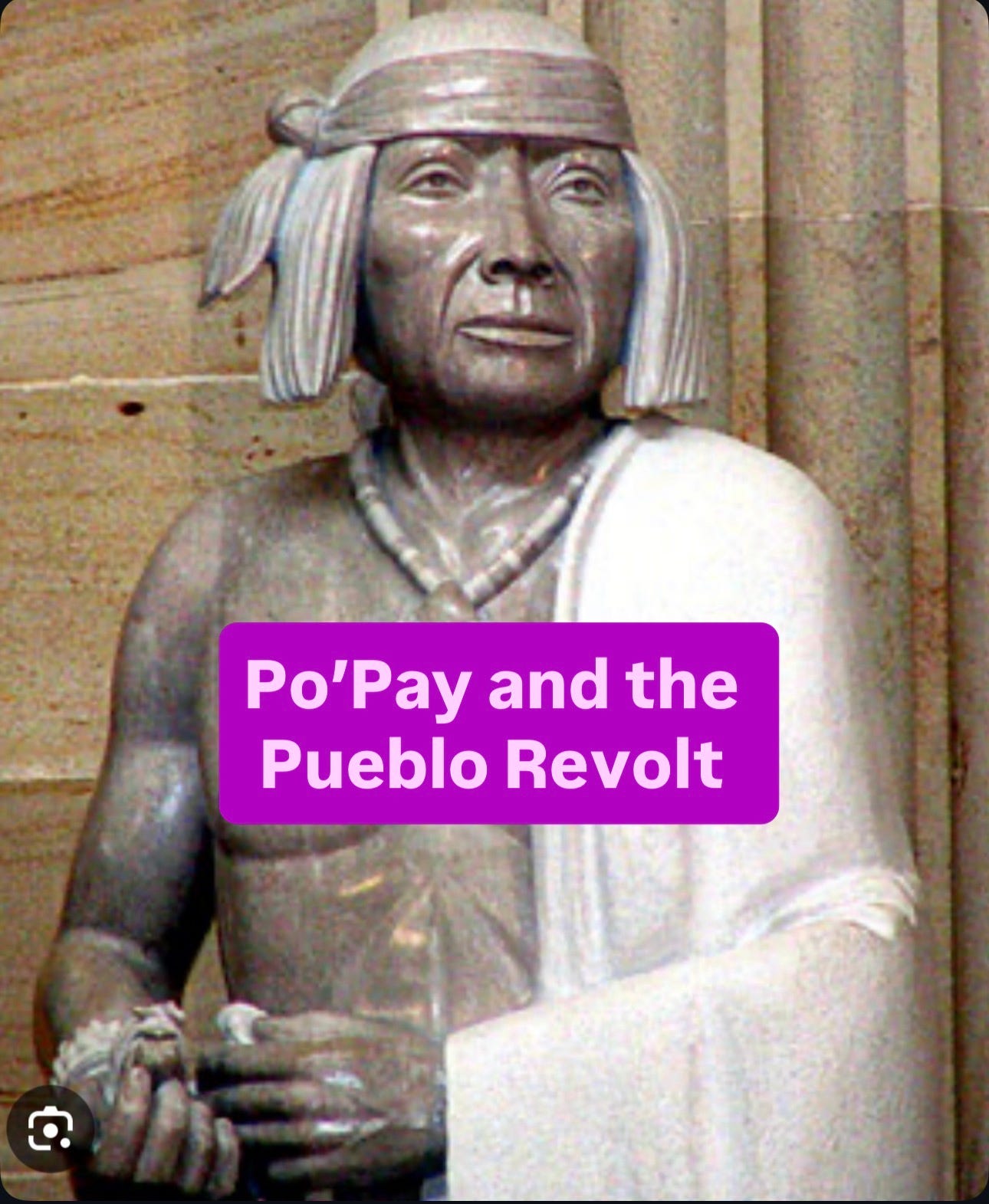
Po’Pay and the Pueblo Revolt, 1680
Visitors to Statutory Hall in Washington, D.C. are greeted by 100 statues, two for each state in the Union. Most of the statues commemorate the contributions of presidents, senators, and governors. However, one statue from New Mexico is very different from the others. It is dedicated to a proud Pueblo religious leader named Po’Pay.
During the 17th century, the Spanish gradually gained control over New Mexico and the Pueblo people. The Spanish disrupted the Pueblo’s traditional culture by forcing them to labor on encomiendas and worship in Spanish missions. By 1680, the Pueblo were on the brink of losing their cultural identity.
“A fierce and dynamic leader”
Contemporaries described Po’Pay as “a fierce and dynamic leader” who deeply resented the Spanish presence in New Mexico. His message was simple – expel the Spanish and return to the old ways of life that had given the Pueblo peace, prosperity, and independence.
Po’Pay faced a daunting challenge. The Pueblo spoke a six different languages and lived in a dozen widely dispersed communities. To coordinate the timing of the uprising, Po’Pay dispatched runners to deliver knotted ropes. Each knot represented a day until the simultaneous strike would begin.
Led by Po’Pay, the Pueblo Revolt began on August 10, 1680. Catching the Spaniards by surprise, the Pueblo insurgents killed over 400 Spaniards and destroyed a number of buildings including all the missions. Stunned by their losses, the Spanish fled south to El Paso.
“This is what was at stake”
The revolt did not bring the Pueblo peace and prosperity. A drought destroyed their crops, and internal divisions weakened their ability to resist the Spanish and nearby tribes. In addition, Po’Pay died in 1688 thus robbing the Pueblo of their inspirational leader. Just four years after Po’Pay’s death, the Spanish began a successful reconquest of the Pueblos.
Although their independence from Spanish rule proved to be short-lived, the revolt had enduring consequences. Realizing that their attempt to rule with an iron hand had failed, the Spanish adopted new and more conciliatory measures. They stopped the violent suppression of Pueblo tribal ceremonies and largely abandoned the encomienda system in favor of a new arrangement based upon regulated wage labor.
Jon Ghahate is an educator at the Indian Cultural Center in Albuquerque, New Mexico. He stresses the importance of the Pueblo Revolt when he tells visitors, “If they had lost, we would not be here. This is what was at stake in 1680. I would not be here, and the language of our ancestors would not be here.”
So why should you remember the Pueblo Revolt? APUSH test writers expect you to know that the Pueblo Revolt led the Spanish to adopt a greater accommodation to Native American culture. The Pueblo Revolt can also be featured in a Long Essay Question (LEQ) asking you to evaluate the causes of conflict among Europeans and Native Americans from 1500 to 1754.