


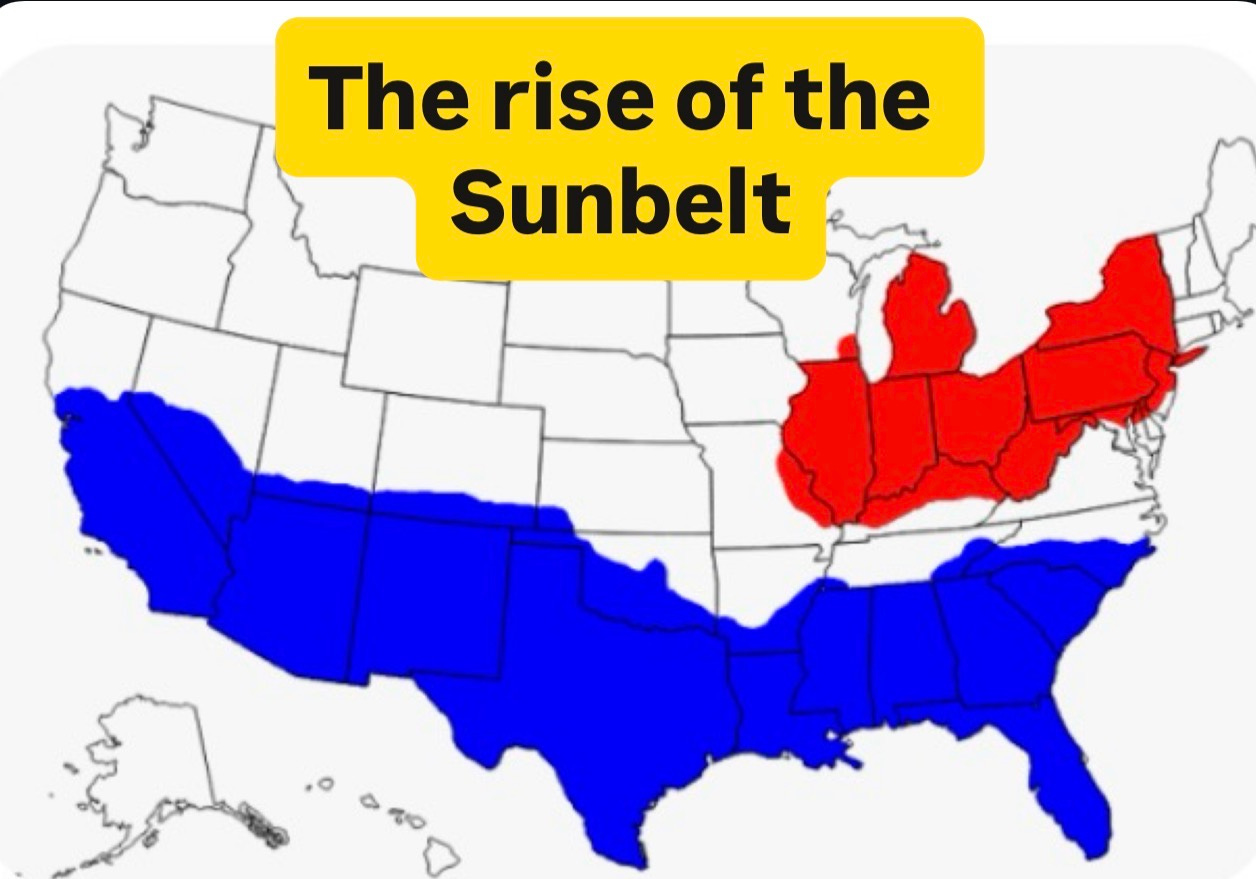
Chicago’s traffic jams, frigid temperatures, and piles of snow left Tom Garrison feeling frustrated. He remembered thinking, “There has to be a place where the sky isn’t the color of a wet sidewalk.” Garrison’s search for a better place to live with a “vast blue sky” took him to Phoenix, Arizona.
Garrison wasn’t alone. Between 1950 and 1980, millions of Americans moved from Rust Belt cities like Chicago to Sunbelt cities like Phoenix. As you can see in our map, the Sunbelt includes portions of 16 states from southern North Carolina through Florida and Texas to Arizona and southern California.
The Refrigerator Revolution
Before the 1950s, the intense heat and humidity of the South and the hot arid deserts of the Southwest deterred large-scale settlements in these regions For example, in 1950, the population of Phoenix was just 106,818. At that time, it was the 99th largest city in the United States.
Air conditioning changed everything. The widespread adoption of central air conditioning transformed Phoenix from a desert outpost into a booming metropolis. One new resident recalled that “people thought we were crazy to move to a place where the temperature hits 110 degrees. But by the mid-1970s, we had ‘refrigerated air.’ You’d dash from your air-conditioned car into your air-conditioned office and then go home to a chilled living room.” He concluded that, “the heat had become a novelty rather than a threat. We traded shoveling snow for staying indoors in July – it seemed like a fair swap.”
The “fair swap” convinced a wave of migrants to move to Arizona. By 1980, Phoenix boasted a population of 789,704 making it America’s 9th largest city. Phoenix was not an isolated example of population growth in the Sunbelt. Between 1950 and 1980 the population of Florida soared from 2.77 million to 9.74 million while the population of Texas doubled from 7.71 million to 14.22 million.
Defense and High-Tech Jobs
During the Cold War the federal government poured billions of dollars into the economies of the Sunbelt states. The region’s vast open spaces made it ideal for year-round training. As a result, aerospace and defense contractors like Lockheed and Boeing built massive plants. In addition, high-tech companies like Motorola and Intel also opened major facilities.
“A middle-class guy could live like a king”
Affordable housing also contributed to the appeal of living in the Sunbelt cities and suburbs. For example, a migrant from San Francisco marveled at his family’s ability to purchase a ranch-style house in Scottsdale, Arizona “for a price that would have barely gotten us a studio apartment back in San Francisco.” He enthusiastically encouraged others to move to a place “where a middle-class guy could live like a king on a modest paycheck.”
Retirement communities
A combination of Social Security checks and generous pensions enabled more and more people to retire in Florida and Arizona. Soon massive retirement communities sprang up in both states.
So why should you remember the rise of the Sunbelt. College Board APUSH test writers have used LEQ and SAQ free-response questions to underscore the importance of the mass migration of people to the Sunbelt. For example, students should know that air conditioning provides an example of a technological innovation that changed American society in the period between 1950 and 2000. In addition, APUSH students should be able to compare the mass migration to the Sunbelt with the mass migration of African American to cities in the Midwest and Northeast.