


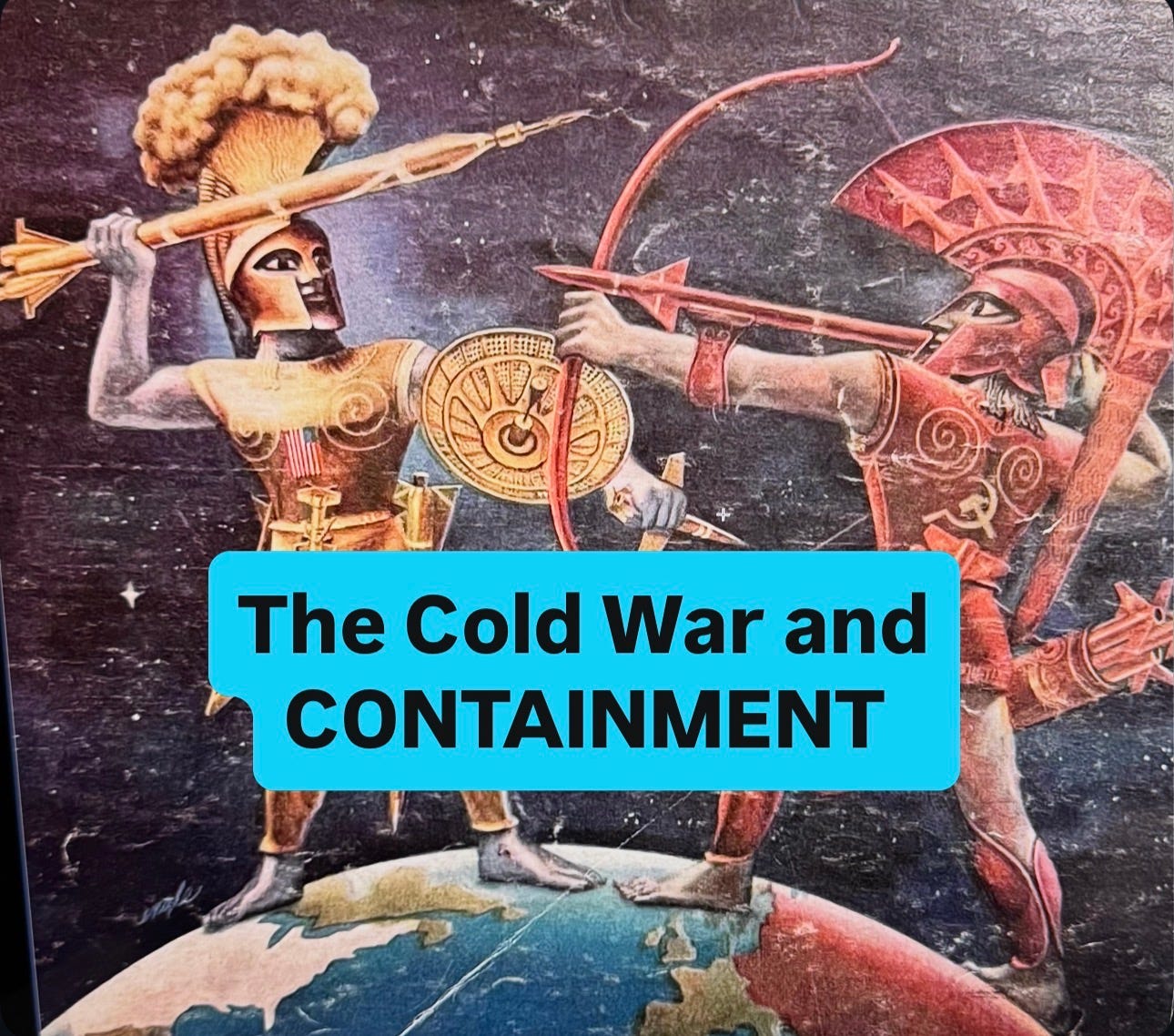
THE COLD WAR and CONTAINMENT
The defeat of Germany and Japan left the United States and the Soviet Union as the world’s two remaining great powers. Americans optimistically hoped that peace would mean a world in which democracy and freedom would prevail. “We really believed in our hearts,” one White House advisor later recalled, “that this was the dawn of the new day we had all been praying for and talking about for so many years.” Yet within a short time this hopeful spirit vanished and the United States and the Soviet Union became bitter rivals in a prolonged period of economic and political rivalry known as the Cold War.
“A blue piece of paper”
Russian dictator Joseph Stalin did not limit Soviet expansion to dominating Eastern Europe. In early 1947, the lengthening shadow of Soviet pressure threatened to undermine the independence of Greece and Turkey. Conditions were particularly perilous in Greece, where a civil war raged between Communist insurgents and supporters of the pro-Western Greek government. Alarming reports from Greece warned that the government faced imminent collapse.
The already desperate situation in Greece became even worse when the British ambassador to the United States delivered an urgent “blue piece of paper.” The formal message informed the Truman administration that Great Britain could no longer afford to give aid to Greece and Turkey. An American official correctly appraised the historic significance of the British message when he noted, “Great Britain within the hour handed the job of world leadership with all its burden and all its glory to the United States.”
George Kennan and Containment
Stalin’s aggressive support for Communist insurgents in Greece did not surprise George Kennan. A leading U.S. State Department expert on Russian history, he believed that Soviet hostility toward the capitalist nations would remain a constant factor for years to come. In an influential Long Telegram and subsequent essay published in Foreign Affairs, Kennan argued that Communist ideology led Soviet leaders to believe that “the outside world was hostile and that it was their duty eventually to overthrow the political forces beyond their borders.”
Given the antagonism between communism and capitalism, Kennan urged the United States to adopt a policy of “long-term, patient but firm, and vigorous containment of Soviet expansive tendencies.” By CONTAINMENT, Kennan meant adopting a strategic policy of blocking the expansion of Soviet military power and Communist ideology.
The Truman Doctrine
President Truman agreed with Kennan’s argument that an unbridgeable ideological chasm divided the United States and the Soviet Union. He therefore accepted America’s responsibility to contain Soviet expansion. On March 12, 1947, Truman asked a joint session of Congress for $400 million in economic aid and military assistance for Greece and Turkey.
Truman did not stop with a request for money. The United States, he declared, could survive only in a world in which freedom flourished. He then articulated what came to be known as the Truman Doctrine: “I believe it must be the policy of the United States to support free people who are resisting attempted subjugation by armed minorities or outside pressures.”
Congress overwhelmingly approved Truman’s request for economic aid to Greece and Turkey. American aid then played a vital role in helping these two countries successfully resist Soviet pressure.
A fateful turning point
The Truman Doctrine marked a fateful turning point in American history. After the First World War, America withdrew into isolationism, leaving Europe to contend with its own problems. As the leader of the Free World, the United States now recognized its responsibility to protect Europe, defend freedom, and use its power to limit the spread of Soviet influence. “The free people of the world look to us for support in maintaining their freedom,” declared Truman. “If we falter in our leadership, we may endanger the peace of the world.”
The drawing that introduces this essay provides a striking visual representation of the Cold War between the United States and the Soviet Union. Dressed in a suit of golden armor, the American warrior defends individual freedom against a rival red Soviet warrior who represents dictatorship and absolute conformity.
So why should you remember the Cold War, Truman Doctrine, and containment? The commitment to containment dominated American foreign policy from 1947 to the collapse of the Soviet Union in 1991. The term containment plays a prominent part in the answer of at least a dozen multiple-choice questions. It also plays a role in LEQ questions asking students to analyze changes in American foreign policy from 1945 to 1991.