


TOBACCO and SLAVERY in COLONIAL VIRGINIA
PART III
WILLIAM BYRD II
RECONCILED SLAVERY and LIBERTY
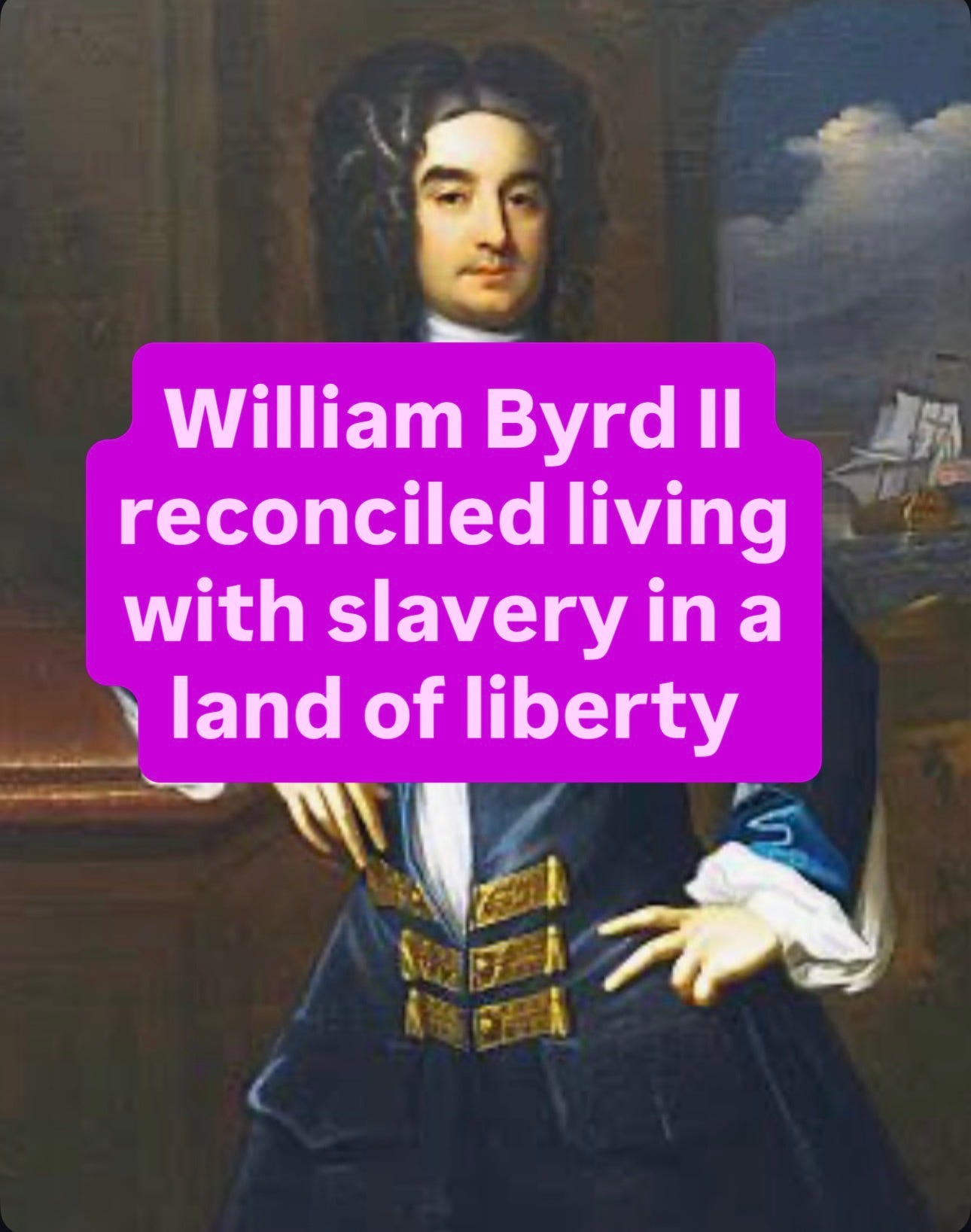
I would like to begin this essay by introducing you to William Byrd II. Byrd was 50 years old in 1724 when he sat for this handsome portrait. At that time, he was one of the wealthiest and most influential planters in colonial Virginia. The artist portrayed Byrd as a supremely confident planter who was in full control of himself, his family, and his slaves.
Westover
Byrd lived in Westover; a gracious plantation located along the banks of the James River midway between Jamestown and Richmond. Vessels regularly tied up at the plantation’s docks to deliver elegant furniture, stylish clothes, and other prized manufactured goods from England. The vessels then returned to London with cargoes of tobacco.
Byrd was a highly cultivated gentleman. His classical education at a private school in England included lessons in Greek and Latin along with readings in French, Italian, and Hebrew. As a scholar with wide-ranging interests, Byrd amassed a personal library with over 3,500 books.
A secret diary
In addition to reading his books, Byrd wrote a secret diary. As a result, we know a great deal about his daily activities and attitudes towards the world around him. Byrd began a typical day by reading passages from the Bible along with verses from Homer’s Odyssey and other Greek classics. His afternoon included playing billiards with distinguished guests and then eating a hearty dinner. Byrd ended his day by thanking God for his good health and good fortune.
Byrd’s prayers did not include thoughts for the hundreds of enslaved Africans who labored in Westover’s tobacco fields and docks. Sections from his secret diary indicate that Byrd viewed enslaved Africans as his personal property. In striking passages that are painful to read, Byrd describes how he punished his slaves with whippings and by forcing them to drink their own urine. How did a cultured gentleman like William Byrd II reconcile owning slaves with his proud belief that Virginia was a land of liberty?
A society with slaves
Byrd was just 2 years old when Bacon’s Rebellion erupted across Virginia’s Tidewater region. At that time, Virginia was still a society in which white indentured servants outnumbered enslaved Africans by 5 to 1. Slavery was thus not yet an integral part of Virginia’s rapidly growing plantation economy.
A slave society
Bacon’s Rebellion alarmed Virginia’s wealthy tobacco planters. They recognized that their reliance on indentured servants poured a large number of indentured servants into a society with limited opportunities for advancement.
By the early 1700s, Byrd and other planters concluded that investing in enslaved Africans was more economical and less dangerous than investing in indentured servants. As a result, the percentage of enslaved Africans in Virginia steadily increased. By 1750, enslaved Africans comprised 43 percent of Virginia’s total population. As a result, Virginia transformed from a colony where slavery existed to a colony dominated by its economic commitment to slavery.
Legal support
Slavery could not become a atable and enduring institution without legal support, In 1705, the Virginia General Assembly enacted a series of laws that codified slavery as a system of race-based, inherited, and perpetual bondage. The law further established a system of harsh punishments designed to enforce strict racial boundaries. For example, ministers who performed an interracial marriage were fined 10,000 pounds of tobacco.
A contradiction
Byrd and other leading Virginians boasted that their colony was a “Land of Liberty” where republican rights and self-government flourished. Yet at the same time they contradicted this belief by denying legal rights to 40 percent of the colony’s population.
Byrd and his contemporaries did not see a contradiction between owning slaves and proclaiming republican principles. They viewed slavey as an economic necessity. Tobacco cultivation required a large supply of inexpensive laborers. The enslaved Africans proved to be a profitable and essential economic investment.
A lack of moral outrage
The majority of white families in Virginia did not own slaves. However, few if any, questioned human bondage as morally unacceptable. Slavery and racism soon became inseparably intertwined in Virginia. Impoverished farmers and wealthy planters like William Byrd found a shared identity in a rigid social hierarchy in which every white person was superior to every black person. The lack of moral outrage enabled slavery to grow and endure.
So why should you remember William Byrd II? Byrd’s career and views provide a vivid illustration that can help you respond to free-response questions asking you to analyze the causes of the development of the institution of slavery in Virginia in the eighteenth century. It can also provide concrete evidence for short-answer questions asking you to describe similarities and differences between the economies that developed in Virginia, Massachusetts, and Pennsylvania.