


INCONGRUOUS and ANALOGOUS have emerged as very common answer choices for recent SAT vocabulary in context questions. One of my first Substack posts explained why volcanoes and geysers are best described as ANALOGOUS and not INCONGRUOUS. Let’s review these two terms and then apply them to a new set of natural phenomena.
INCONGRUOUS is used to describe a situation in which something doesn’t fit and is therefore out of place. In contrast, ANALOGOUS is used to describe two different things that nonetheless share a common similarity.
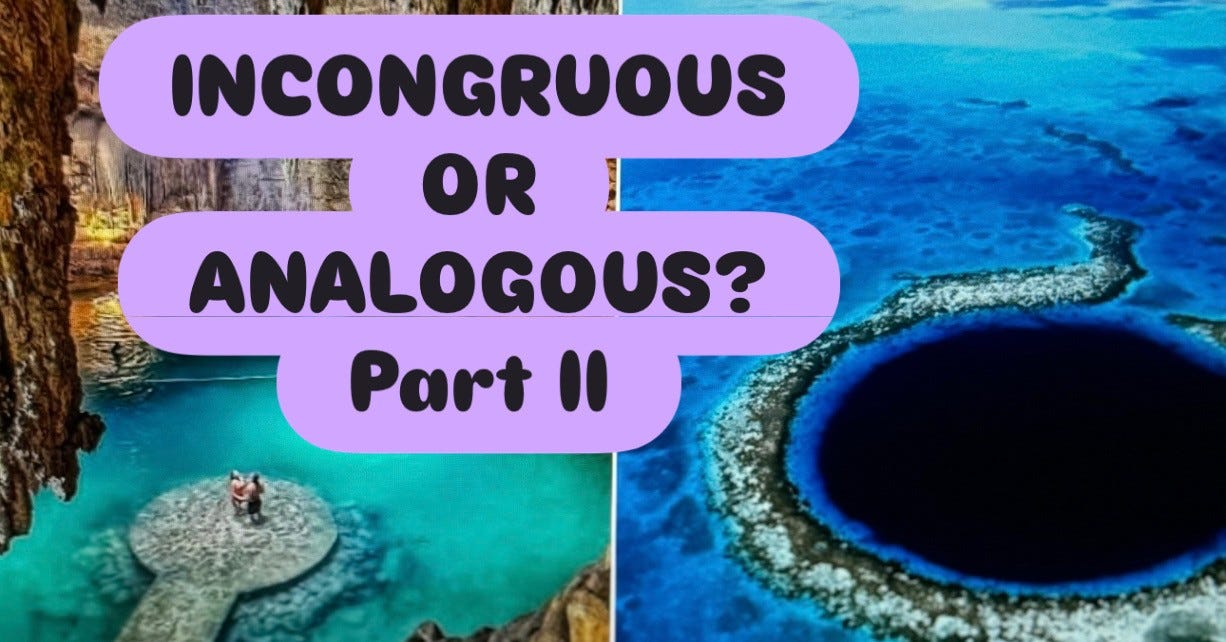
A recent SAT vocabulary in context question asked students to compare cenotes and blue holes. As you can see in the picture on the left, cenotes are natural water-filled sinkholes that offer unique crystal-clear water for swimming, snorkeling, and diving. In contrast, blue holes like the one pictured on the right, are underwater caves that appear dark blue because their great depth contrasts with the surrounding water.
Cenotes and blue holes are normally not considered ANALOGOUS. But, this is the SAT! Although cenotes and blue holes differ in size, composition, and recreational uses, they are ANALOGOUS because both are water-filled sinkholes produced by the natural dissolution and collapse of limestone rocks. Although it is tempting to believe that cenotes and blue holes are INCONGRUOUS, remember that on the SAT they are ANALOGOUS!